Legislative Update
Minnesota Fraud Monitor – February 2026 Edition
Friends,
Each month, we release a report highlighting developments in the fight against fraud in Minnesota’s state government, along with the steps we are taking to stop it, hold bad actors accountable, and protect taxpayer dollars.
Cleaning this up remains a top priority. It’s the first step toward addressing many of the broader challenges we face, whether it’s improving affordability, lowering taxes, or making sure government programs actually deliver results for the people they’re meant to serve.
Minnesotans deserve better, and we have a responsibility to get this right. I appreciate you staying engaged and continuing to call for real accountability.
Office of Inspector General Late Breaking Update:
Despite public statements suggesting support for an Office of Inspector General, the versions put forward by House Democrats and the Governor remove the very authority that would make it effective. Their approach creates another layer of bureaucracy that can issue reports but cannot enforce the law or stop fraud in real time. This gets to the heart of the disagreement. Whether Minnesota will have an OIG with real enforcement power or simply another office that makes recommendations.
February Review
This update focuses on the month of February. Additional developments have already taken place this month, and we’ll be sharing a more complete update in the coming weeks once all the information is compiled.
For now, take a look at what happened throughout the past month below.
Shining a Light on Fraud & Mismanagement of Your Tax Dollars
The 2026 legislative session resumed in February, bringing with it a renewed focus on fraud prevention, program integrity, and oversight in state-administered programs. This month included the long-awaited 3rd-party report of DHS’ 14 high-risk programs from Optum (what we could read), new prosecutions of fraudsters, another MN legislator testifying in Washington, DC, and a return to both productive and hotly contested policy discussions at our state’s Capitol.
Timeline
Feb. 4: U.S. Senate Judiciary Subcommittee hearing
Representative Kristin Robbins testified before the U.S. Senate Judiciary Committee’s Subcommittee on Federal Courts, Oversight, Agency Action, and Federal Rights. Robbins laid out a chronology that traced the roots of Minnesota’s current fraud crisis; agency officials’ competency and accountability was questioned, with whistleblower retaliation being a central focus; and current concerns were emphasized regarding poor internal controls and insufficient accountability measures. Senator engagement was almost exclusively framed within partisan frameworks – with Democrats largely deflecting fraud concerns to the Trump Administration, and Republicans zeroing in on questions about Minnesota’s fertile fraud environment. (1) (2) (3)
Feb. 6: Optum delivers vulnerability assessment report; redactions prompt discussion
Optum delivered their long-awaited report evaluating vulnerabilities, fraud, waste, and abuse in Minnesota’s 14 high-risk Medicaid programs. The highly anticipated report did little to alleviate concerns or instill confidence. (4) (5) (6)
The immediate point of contention was apparent when significant portions of the public version of Optum’s report were redacted. DHS officials cited concerns about security-sensitive information and proprietary content. The Star Tribune similarly reported DHS and others raising trade-secret and security-related concerns as reasons for the limited disclosure. More critical explanations suggest that the report was so explosive, and programs so vulnerable, that not redacting significant portions would worsen the current fraud epidemic. (5) (6)
The redactions prompted a clear debate with two competing concerns:
- Risk-control concern: releasing unredacted details could temporarily function as a roadmap for bad actors by highlighting specific systemic weaknesses faster than fixes can be implemented. Put bluntly, the oversight gaps currently in place in Minnesota’s 14 high-risk programs are explosive and still extremely vulnerable.
- Accountability concern: without greater access to what the review found, policymakers and the public may lack a shared baseline to understand urgency and evaluate the scope and direction of proposed reforms. In other words, if we want to get serious about stopping fraud, the public/taxpayers (not to mention elected officials) deserve to know just exactly what the reality is that our state is grappling with.
Following the report’s release, Rep. Schomacker – co-chair of the Human Services Committee – began drafting a bill to provide the unredacted Optum report to legislators in committees of jurisdiction, while restricting dissemination of nonpublic data and allowing limited redactions for Optum proprietary information. Deliberations and urgency to allow release of the Optum report to (at least some) legislators, as well as to grapple proactively and effectively with the findings within the report itself, were significant points of emphasis for the legislature throughout the month of February. (5) (7)
Feb. 10: Guilty pleas in now-defunct Housing Stabilization Services (HSS)
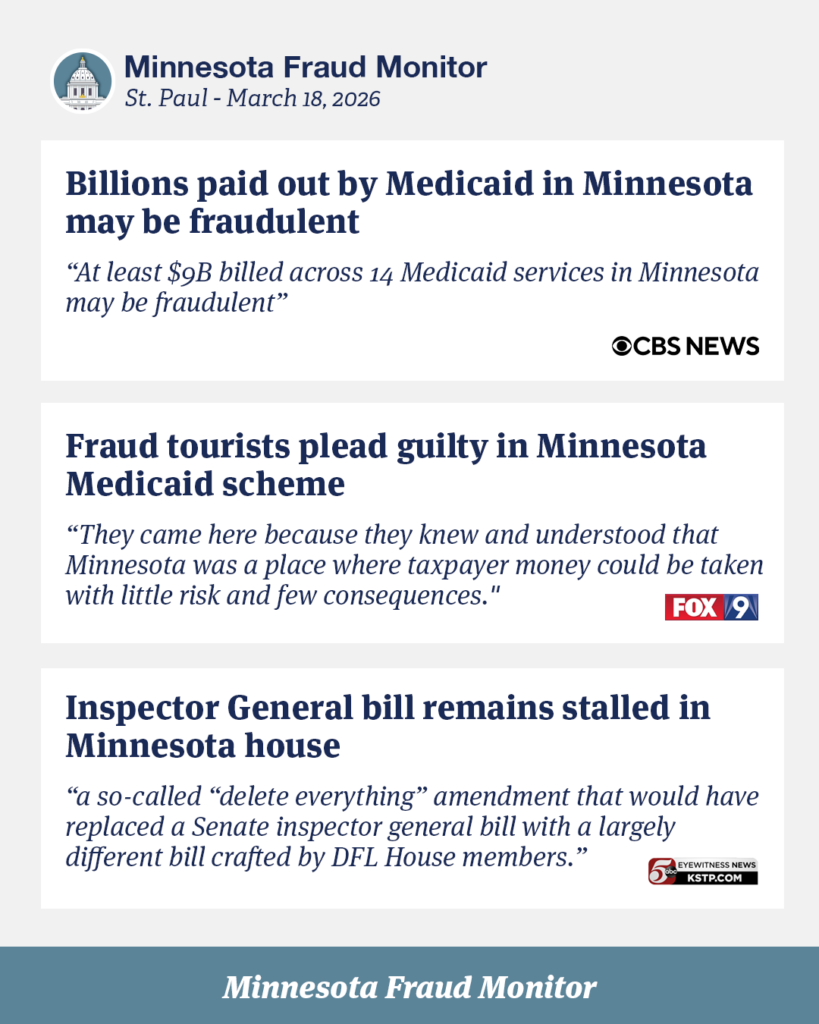
Two Philadelphia natives pleaded guilty in federal court in a case involving Minnesota Medicaid billing for Housing Stabilization Services. The Department of Justice reported the scheme involved approximately $3.5 million tied to about 230 beneficiaries, for whom the pair fabricated documentation at the state’s expense. The pair fit under the umbrella of the “fraud tourist” moniker coined by former US Attorney Joe Thompson, a reference to the enticing fraud environment in Minnesota that saw a purported influx of out-of-state fraudsters eager to take advantage of the lax Medicaid landscape in our state. Sentencing remains pending. (8) (9) (10)
Feb. 18–20: Additional charge in Feeding Our Future
Federal prosecutors charged an individual in connection with alleged inflated meal claims at a daycare center participating in the Feeding Our Future program. Court documents, as described in reporting, allege extremely high meal volumes, with the center receiving over $850,000 while spending far less on food. This brought the total charged individuals involved in the Feeding Our Future scandal to 79. The nation’s largest COVID-era fraud scandal continues. (11) (12)
Feb. 23: HF3542 (Hudson) heard and advanced
With the 2026 legislative session beginning in the middle of February, so also began the return to new ideas and bills being deliberated upon within the evenly divided House of Representatives. Representative Walter Hudson presented one of the session’s first fraud bills at the Fraud Prevention and State Agency Oversight Policy Committee.
Rep. Hudson’s bill would require the Department of Human Services, and the Department of Children, Youth, and Families, to disclose (upon formal legislative/MGDPA request) the existence of investigations into entities that are suspected of fraud. Critically, this requirement is only applicable once payments have already been paused to the respective entities in order to avoid alerting the parties of concern to an ongoing investigation that has not stopped payment. Hudson’s bill – HF3542 – was approved and referred to the House Children and Families Committee. (13) (14)
Feb. 23: “Roadmap to Program Integrity and Fraud Prevention” released
The state released a “Roadmap to Program Integrity and Fraud Prevention” outlining steps and priorities related to fraud prevention, oversight, training, and enforcement. The document was created by Tim O’Malley, the Director of Program Integrity – a position created by executive order back in December 2025. The report was praised on both sides of the aisle as a sober accounting of Minnesota’s fraud landscape. The report offered a historical chronology of the cultural and statutory landscape – within DHS and the legislature, respectively – a diagnosis of current areas of significant concern, and recommendations for rectifying the current fraud environment, were all outlined. While the report itself was widely praised, the subsequent roadmap and energy for the legislature and DHS to apply the prescribed fixes has been less clear or universal. (15) (16) (17)
Office of Inspector General (OIG)
One of the first major state-level oversight debates of the new session was as highly contested in the House as it was at the conclusion of the 2025 session – the establishment of a statewide Office of Inspector General. Broadly speaking, disagreement centered on appointment independence, authority, cost, and interaction with existing enforcement and agency Inspector General functions. (18) (19) (20) (21)
Representative Patti Anderson initially brought forward the idea of an independent Office of Inspector General at the beginning of the 2025 legislative session with HF1. The bill was completely split along party lines in the MN House, while the MN Senate had broad bipartisan support for the bill, passing it in their body 60-7 in May 2025. Needing support from both bodies of the legislature, the bill ultimately failed. The debate, however, has continued. (18) (22) (23)
In the House State Government Finance and Policy Committee, Rep. Matt Norris offered a delete-all amendment that he claimed would preserve much of the Senate framework while addressing legal concerns, avoiding duplication with the BCA, and incorporating oversight of existing agency inspector general functions. The amendment failed on a 7-7 party-line vote. Republicans argued the DE amendment moved away from the Senate model by removing the proposed in-house law enforcement component and by shifting appointment authority in a way that fundamentally compromises independence from the governor’s office. (19) (20) (21) (22)
Despite public statements suggesting support for an Office of Inspector General, the versions put forward by House Democrats and the Governor remove the very authority that would make it effective. Their approach creates another layer of bureaucracy that can issue reports but cannot enforce the law or stop fraud in real time. This gets to the heart of the disagreement. Whether Minnesota will have an OIG with real enforcement power or simply another office that makes recommendations.
The debate remains ongoing in the House, but a sustained lack of cooperation with House Democrats makes the path to accountability uncertain. (18) (20) (21)
When it comes to accountability, there is little room for compromise.
Conclusion
February made clear that fraud in Minnesota is not an issue going away anytime soon, and while there is reason for optimism, substantial work still remains.
Report Fraud!
Former First Assistant U.S. Attorney Joe Thompson publicly estimated that fraud (tied to just the 14 high-risk Minnesota Medicaid services) is in the billions. (24) If you’ve seen or experienced suspected fraud in state programs, make a confidential report at MNFraud.com and help protect taxpayer dollars.
This edition focuses on documented developments. If you find it useful, consider sharing it with others interested in accountability. Suggestions for future coverage are welcome. Feel free to follow up with me using the contact info found at the bottom of this email.
It looks like we are going to have some good weather coming up.
Have a great weekend!

Bibliography
(1) U.S. Senate Judiciary Committee hearing page (Feb. 4, 2026) https://www.judiciary.
Please Contact Me
Please continue to reach out if I can be of any assistance to you. You can reach me by phone at 651-296-5185 or by email at rep.ben.bakeberg@house.mn.gov.